
Search attractions, restaurants, events...
1 hours
Duration
Free
Free entry
Any time
Best time to visit
Architecture
Category
Origin and urban planning significance (15th century)
The trading dome was founded in the 15th century (during the reign of Mirzo Ulugbek), when Registan Square finally established itself as the main socio-political and commercial crossroads of Samarkand. The word «Chorsu» (chor — four, su — side/direction) reflected its key topographic role: beneath the vaults of the pavilion converged four major thoroughfares leading to the main city gates.
Architectural structure
The structure is a complex multi-domed centric composition built of fired brick:
Geometry: The base is a dodecagon transitioning into a hexagonal volume.
Dome system: The center is crowned by a massive hemispherical dome resting on powerful support pillars. Through-arched passages are cut into each of the six faces, above each of which rises a small dome.
Natural microclimate: The through system of arches created a constant air draft, providing coolness inside the building even at the height of the medieval Central Asian summer.
The era of specialized trade (18th–20th centuries)
In the first half of the 18th century, during the reign of Emir Shahmurad, the building underwent a thorough reconstruction and received the status of a specialized headwear market (tok-i telpak-furushon). Here they sold silk-embroidered skullcaps, turbans, karakul papakhas and oriental fabrics, as well as concluded trade contracts and exchanged currency. At the beginning of the 20th century the bazaar became universal, and in the Soviet period it served as a shop of souvenirs and folk craft items.
Restoration and the Gallery of Fine Arts (2005 — present)
Over the centuries, an almost 3-meter cultural layer of earth accumulated around the building, concealing the lower part of the structure. In 2005, by decision of the government of Uzbekistan, the monument was thoroughly restored: archaeologists removed the layer of soil, revealing the original proportions of the walls and foundations.
In the same year, the site was transferred to the Academy of Arts of Uzbekistan. Today, in the spacious round hall beneath the ancient vaults, rotating exhibitions of contemporary artists, sculptors, masters of chasing, ceramics and traditional textiles of Uzbekistan are regularly held.
Monday: 09:00 – 18:00
Tuesday: 09:00 – 18:00
Wednesday: 09:00 – 18:00
Thursday: 09:00 – 18:00
Friday: 09:00 – 18:00
Saturday: 09:00 – 18:00
Sunday: 09:00 – 18:00
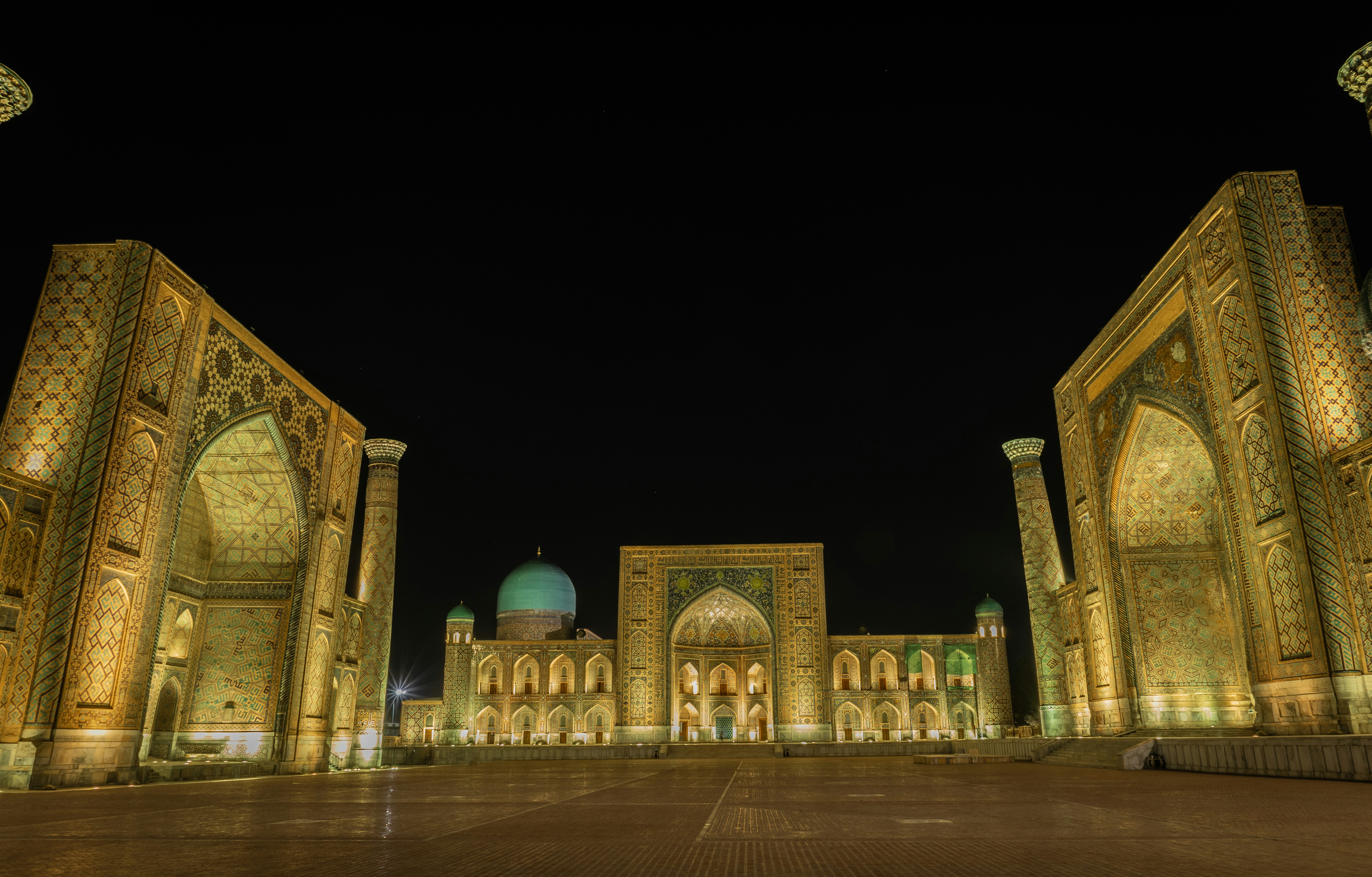
The heart of ancient Samarkand, Registan Square is flanked by three gr…
From 40,000 UZS

Kok-Saray Hill (Samarkand Citadel) is a historic fortress mound in the…
Free entry

Mazar and memorial complex of Faqih Abu Lays Samarkandi is a sacred pi…
Free entry

Mausoleum and Complex of Imam ad-Darimi — a revered religious-memorial…
Free entry