
Search attractions, restaurants, events...
30 min
Duration
Free
Free entry
Daytime
Best time to visit
Spiritual
Category
Historical tradition (11th–12th centuries)
The concept of "namazgoh" (or "musalla") emerged in Islamic urban planning to designate open suburban areas capable of accommodating the entire male population of a city and its surrounding villages during the two main annual holidays.
In pre-Mongol Samarkand of the Karakhanid era (11th–12th centuries), city mosques within the fortress walls could not hold all worshippers, so a special ritual field with a mihrab wall oriented toward Mecca was set aside beyond the southern gates of the city.
A similar planning tradition developed during this period in Bukhara, where the Karakhanid Arslan Khan erected the famous Bukhara Namazga (1119–1120).
Construction by Nadir Divan-begi (17th century)
In the first half of the 17th century (1630s), during the reign of Bukhara Khan Imam Quli Khan, the influential statesman from the Uzbek Arlat clan Nadir Divan-begi (who also built the madrasah at the mazar of Khoja Akhrar in Samarkand and the Lyabi-Khauz ensemble in Bukhara) financed the construction of a substantial architectural complex on the ancient prayer field:
Layout and composition: The building received a frontal portal-dome composition with a central hall covered by a spherical-conical dome and a long open aiwan.
Brick decor: The facades and pylons of the mosque are adorned with patterned brickwork, pointed arches, and a restrained ornamental belt characteristic of late-medieval architecture of Maverannahr.
Festive gatherings: On the days of Hayit, the space before the mosque was filled with tens of thousands of worshippers arriving from across the Samarkand oasis; festive oriental bazaars and folk celebrations unfolded here as well.
Fate of the monument in the 19th–20th centuries
In the late 19th and early 20th centuries, the mosque attracted the attention of researchers and photographers: its grand entrance and interiors were thoroughly documented by the Russian pioneer of color photography S. M. Prokudin-Gorsky in 1911, as well as by architects for the historical "Turkestan Album." During the Soviet and post-Soviet periods, the building underwent reinforcement and restoration works and today stands as a monument of architectural heritage and an active neighborhood mosque.
Monday: 09:00 – 18:00
Tuesday: 09:00 – 18:00
Wednesday: 09:00 – 18:00
Thursday: 09:00 – 18:00
Friday: 09:00 – 18:00
Saturday: 09:00 – 18:00
Sunday: 09:00 – 18:00
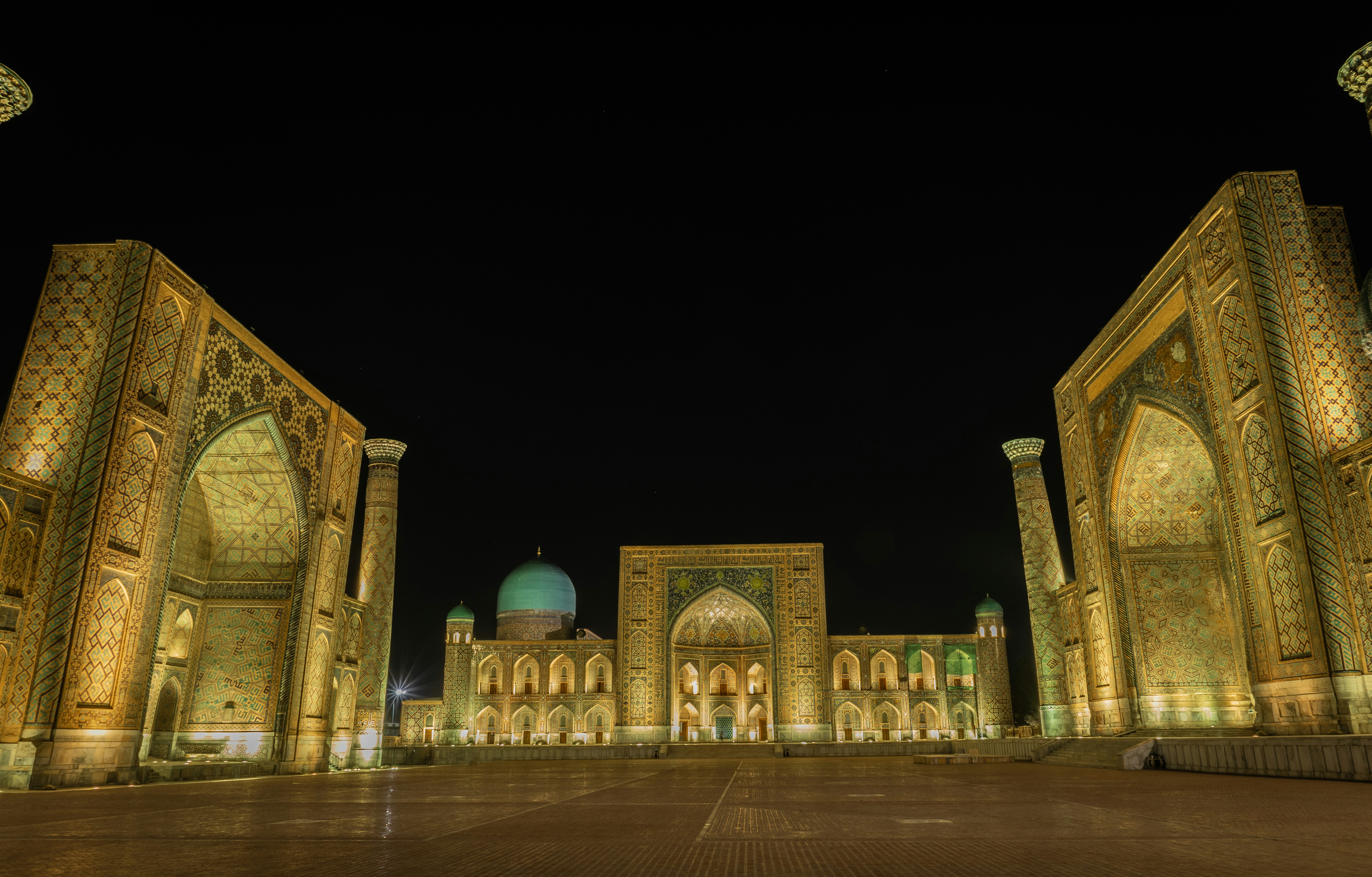
The heart of ancient Samarkand, Registan Square is flanked by three gr…
From 40,000 UZS

Kok-Saray Hill (Samarkand Citadel) is a historic fortress mound in the…
Free entry

Mazar and memorial complex of Faqih Abu Lays Samarkandi is a sacred pi…
Free entry

Mausoleum and Complex of Imam ad-Darimi — a revered religious-memorial…
Free entry