
Search attractions, restaurants, events...
1 hours
Duration
Free
Free entry
Daytime
Best time to visit
Architecture
Category
The Thinker's Personality and Influence
Said Jalal ad-Din Ahmad al-Kasani was born in the city of Kasan (Fergana Valley) and traced his lineage to the Prophet Muhammad. As the successor to the ideas of Khoja Akhrar, Makhdumi A'zam became the greatest spiritual authority of the Shaybanid era. Monarchs heeded his counsel, including the founder of the Mughal dynasty, Zahiriddin Muhammad Babur (to whom the thinker dedicated the treatise «Risolai Baburiya»).
The scholar left over 30 philosophical and theological works, gathered in the collection «Majmua ar-Rasail». Unlike reclusive asceticism, Makhdumi A'zam championed the idea of "active Sufism": Sufis should not merely withdraw into cloisters but work the land, practice crafts, and positively influence society and rulers.
The Founding of Dahbed ("Ten Willows")
In the early 16th century, at the invitation of the Shaybanid sultan Janibek, the sheikh moved to the land between the Akdarya and Karadarya rivers (the Miyankal Valley). According to legend, the saint's first act was to plant ten willow saplings with his own hands — hence the name of the settlement Dahbed (from Persian "Ten Willows"). Later, the sheikh laid out a vast garden covering over 20 hectares, living the life of a simple gardener and mentor to hundreds of murids.
The Architectural Ensemble of the Complex
Sacred dakhma (sufa): A large rectangular stylobate (17.6 × 16.6 m, height 1.55 m) faced with grey Samarkand marble, featuring corner half-columns and carved calligraphy from the Quran. Carved marble steles stand on the platform. The brick enclosure around the sufa was erected in the first half of the 17th century by Nadir divan-begi.
The burial of Yalangtush Bahadur: At the foot of Makhdumi A'zam's dakhma rests the all-powerful ruler of Samarkand, Yalangtush Bahadur (builder of the Sherdor and Tillya-Kari madrasahs on Registan, died in 1656), who regarded the saint's descendants as his spiritual pirs. Nearby lie the gravestones of his daughters (Iklimabonu and Oy Bibi).
Khanaka and cathedral mosque (17th c.): A monumental 12-domed, six-pillared building with an open summer aiwan on carved wooden columns, built by order of Yalangtush Bahadur.
Minaret and 600-year-old tree: In the shady courtyard rises a historic brick minaret, and a colossal four-trunk mulberry tree has survived, estimated to be 600 years old.
Monday: 09:00 – 18:00
Tuesday: 09:00 – 18:00
Wednesday: 09:00 – 18:00
Thursday: 09:00 – 18:00
Friday: 09:00 – 18:00
Saturday: 09:00 – 18:00
Sunday: 09:00 – 18:00
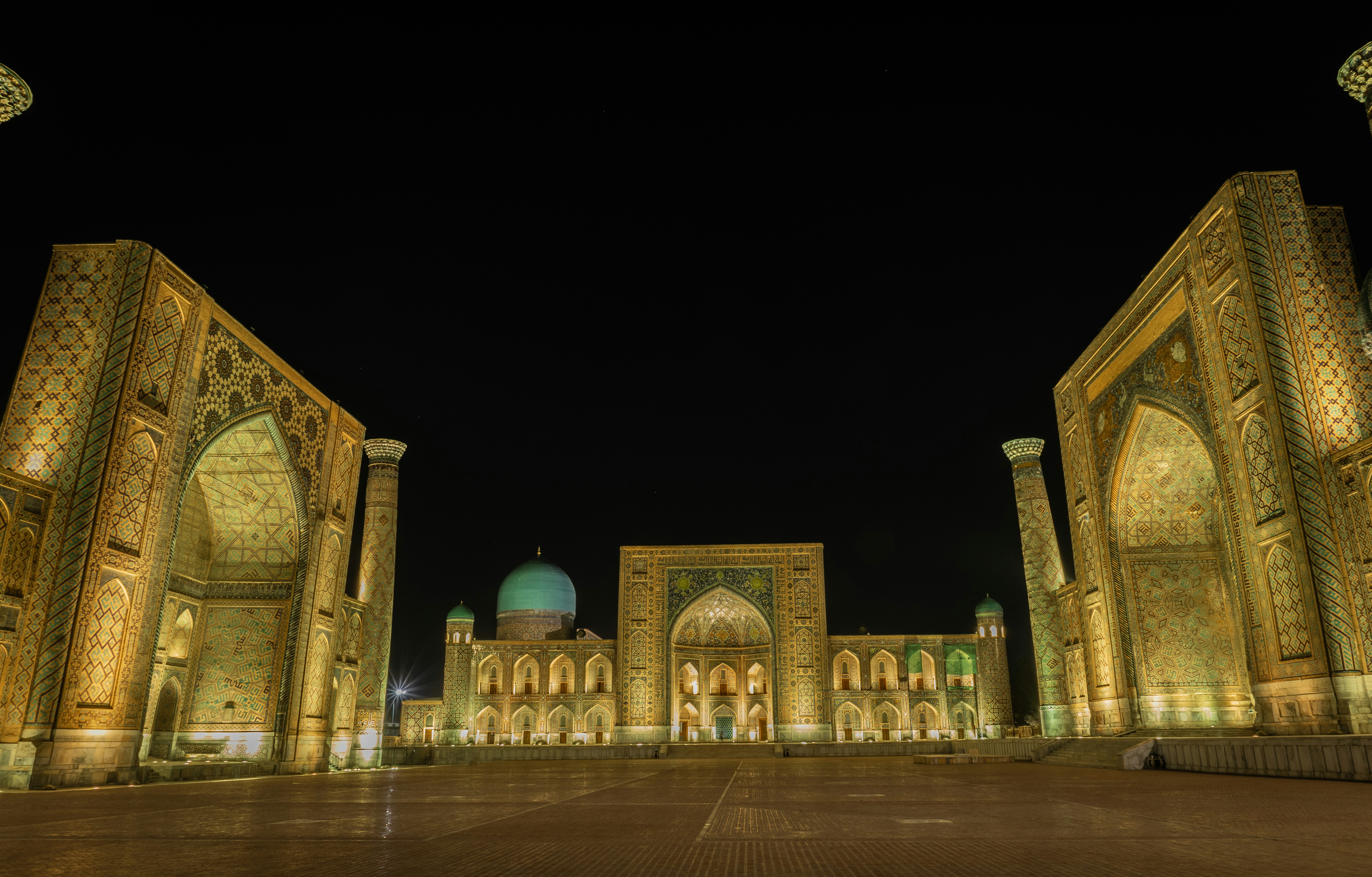
The heart of ancient Samarkand, Registan Square is flanked by three gr…
From 40,000 UZS

Kok-Saray Hill (Samarkand Citadel) is a historic fortress mound in the…
Free entry

Mazar and memorial complex of Faqih Abu Lays Samarkandi is a sacred pi…
Free entry

Mausoleum and Complex of Imam ad-Darimi — a revered religious-memorial…
Free entry