
Search attractions, restaurants, events...
1 hours
Duration
50,000 UZS
per person
Morning or daytime
Best time to visit
Architecture
Category
History of Creation
Construction of the complex began in 1403 by order of Amir Timur after the sudden death of his eldest grandson and official heir to the throne, Muhammad-Sultan. Initially, a madrasah and a khanaka stood on this site, but Timur ordered a monumental mausoleum to be built for the prince's burial.
After Tamerlane's own death in 1405 during his campaign against China, his remains were brought to Samarkand and interred in the same crypt. The final completion of the ensemble and its interior decoration were carried out by the commander's grandson, Mirzo Ulugbek, who also installed the famous carved jade tombstone.
Architectural Appearance
Dome: The building's main dominant feature is a 64-ribbed turquoise-blue dome about 15 meters in diameter, rising on a tall cylindrical drum adorned with monumental Arabic calligraphy.
Entrance group: The facade is decorated with a majestic pishtaq featuring geometric ornaments (girikhs) of glazed brick and polychrome majolica.
Interior and Burials
Main hall: The walls are covered with panels of green onyx, and the domed vault is decorated with gilded relief paintings in the "kundal" technique with stalactite transitions.
Tombstones: Decorative cenotaphs stand in the center of the hall. Tamerlane's tombstone is carved from a single block of dark green jade. The actual historical burials lie directly beneath them in an underground crypt.
Monday: 08:00 – 22:00
Tuesday: 08:00 – 22:00
Wednesday: 08:00 – 22:00
Thursday: 08:00 – 22:00
Friday: 08:00 – 22:00
Saturday: 08:00 – 22:00
Sunday: 08:00 – 22:00
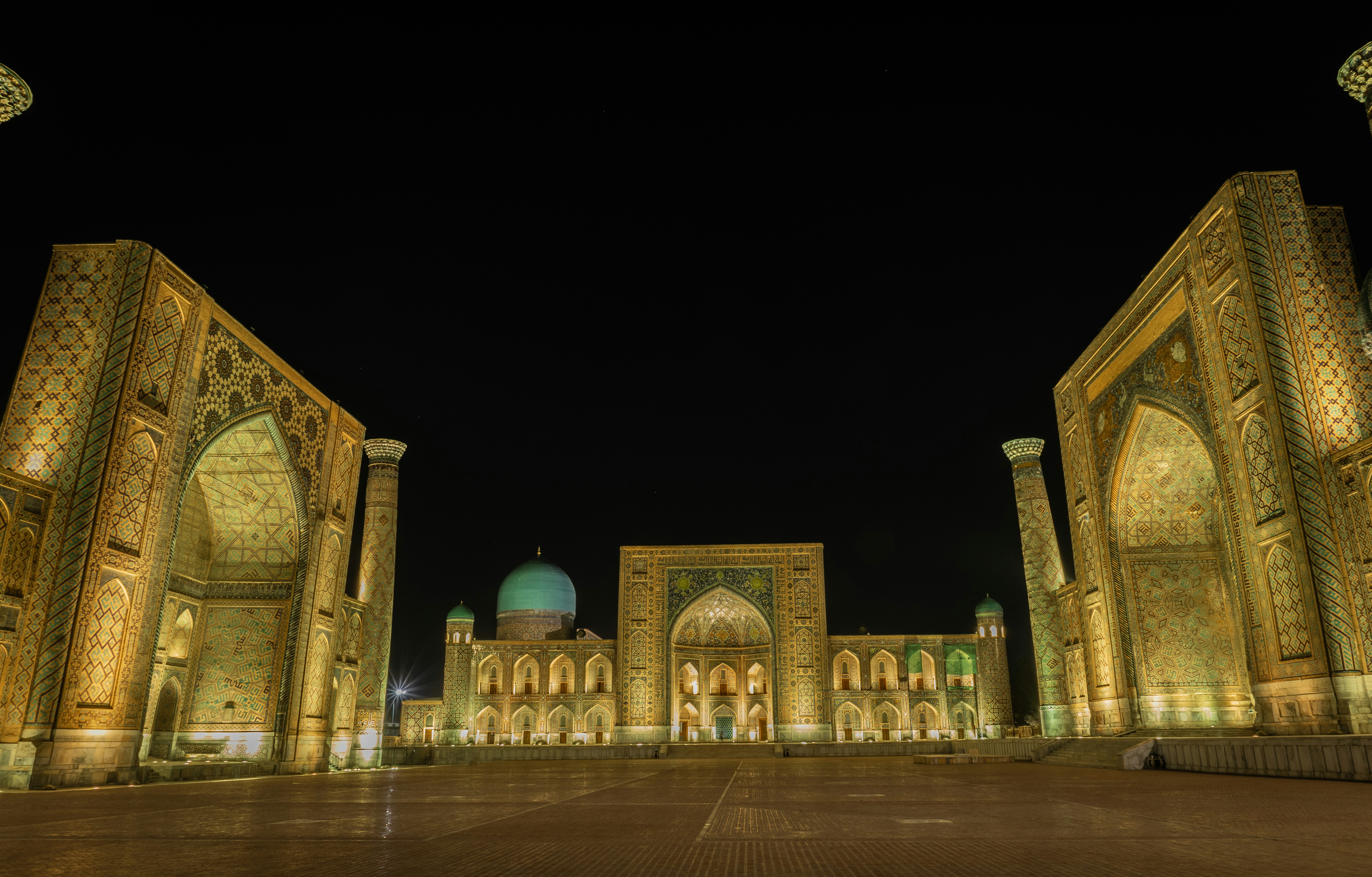
The heart of ancient Samarkand, Registan Square is flanked by three gr…
From 40,000 UZS

Kok-Saray Hill (Samarkand Citadel) is a historic fortress mound in the…
Free entry

Mazar and memorial complex of Faqih Abu Lays Samarkandi is a sacred pi…
Free entry

Mausoleum and Complex of Imam ad-Darimi — a revered religious-memorial…
Free entry