
Search attractions, restaurants, events...
1 hours
Duration
Free
Free entry
Daytime
Best time to visit
Architecture
Category
The Personality of Khoja Akhrar Vali
Sheikh Nasir ad-din Ubaidallah ibn Mahmud Shashi (Khoja Akhrar Vali) was born near Tashkent and became one of the most significant figures of the Muslim East in the 15th century. Heading the Sufi brotherhood of Naqshbandiya, he held unquestionable spiritual and political authority among the Timurid rulers (Abu Said, Sultan Ahmed, and the young Babur). Khoja Akhrar used his influence to reconcile warring monarchs, protect the common people from exorbitant taxes, and abolish ruinous levies (tamga).
History of the Complex's Formation
The Sheikh's Abode (15th century): In the second half of the 15th century, Khoja Akhrar founded a Sufi khanaka in the village of Kafshir and dug a reservoir. After his death in 1489/1490, a carved stele of white marble was erected over his grave, whose epitaph is recognized as a masterpiece of Islamic calligraphic art. The mazar instantly became a universally revered Muslim shrine.
Construction of the Nadir Divan-begi Madrasah (1630–1635): A century and a half later, the all-powerful vizier of the Bukhara Khanate, Nadir Divan-begi, built a monumental madrasah beside the mazar (chief architect — Dust Muhammad, head of works — usto Khoja Hashim) and a summer mosque.
Architectural Features (the "Mirror of Sherdor")
Portal with tiger-lions: The tympanum of the madrasah's main portal is adorned with heraldic mosaic — a scene of fantastic tiger-lions chasing white does beneath the rays of a rising sun with a human face. This motif echoes the portal of the Sherdor Madrasah on Registan Square, for which the Samarkandis dubbed the complex the "mirror of Sherdor" or the "outer Sherdor."
Madrasah layout: The building comprises 27 single-story hujras. Unlike other madrasahs, there are no corner lecture halls (darskhana) here — instead, elegant pentagonal niches with passages were made, allowing the new building to be organically integrated with the old khanaka.
Mosque and carved aivans: Along the courtyard stretches an ensemble of summer and winter mosques. The 17th-century wooden aivan rests on columns with composite stalactite capitals and marble bases, while the ceiling is adorned with coffers (khavzaks) and the finest ornamental painting.
Hauz and plane trees: The centerpiece of the composition remains the octagonal 15th-century reservoir, surrounded by giant plane trees over 500 years old and a hexagonal minaret built in 1909 (architect Sagdulla).
Monday: 09:00 – 18:00
Tuesday: 09:00 – 18:00
Wednesday: 09:00 – 18:00
Thursday: 09:00 – 18:00
Friday: 09:00 – 18:00
Saturday: 09:00 – 18:00
Sunday: 09:00 – 18:00
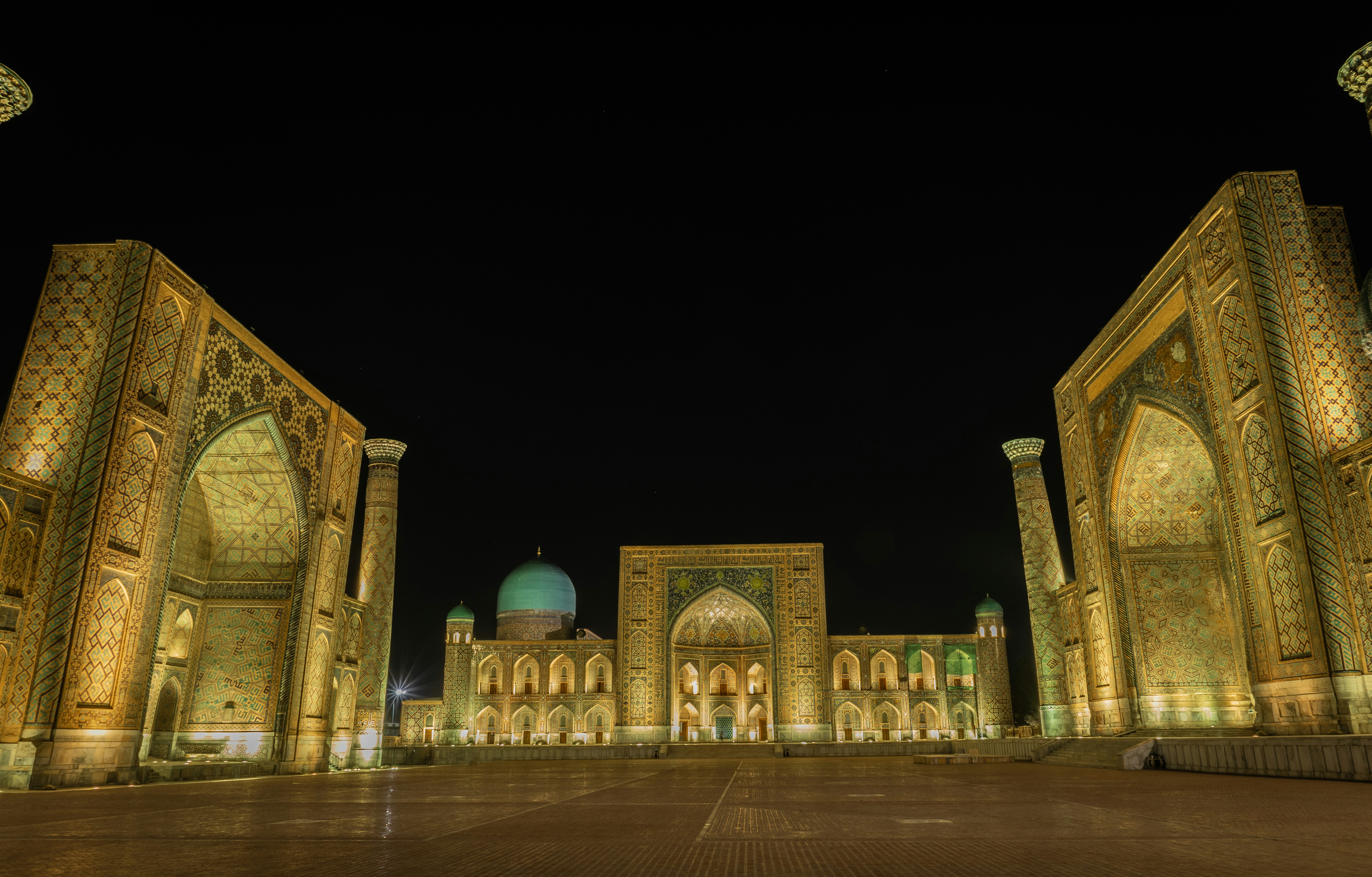
The heart of ancient Samarkand, Registan Square is flanked by three gr…
From 40,000 UZS

Kok-Saray Hill (Samarkand Citadel) is a historic fortress mound in the…
Free entry

Mazar and memorial complex of Faqih Abu Lays Samarkandi is a sacred pi…
Free entry

Mausoleum and Complex of Imam ad-Darimi — a revered religious-memorial…
Free entry