
Search attractions, restaurants, events...
30 min
Duration
Free
Free entry
Daytime
Best time to visit
Spiritual
Category
Origin of the shrine and the meaning of the word "Berun"
The founding of the mazar is associated with the name of Said Abd-i ibn Yakub — a descendant of the Prophet Muhammad and a respected judge (qazi) of 9th-century Samarkand, renowned for his honesty and deep knowledge of Islamic law.
The prefix "Berun" (or "Birun", from Pers./Taj. "outer") indicates the geographical location of the sanctuary — beyond the ring of medieval fortress walls of Samarkand. The complex forms a spiritual pair with the ensemble "Khodja Abdi Darun" ("inner"), located within the old city. According to historical tradition, the spacious suburban complex of Berun was intended for large-scale worship and collective pilgrimage (ziyarat) of hundreds of believers during the main holidays.
History of construction (17th century)
The first structures over the burial appeared in the 12th century during the reign of the Seljuk sultan Sanjar, but were destroyed during the Mongol invasion in 1220.
The revival of the mazar in its modern monumental form took place in 1633–1636 thanks to Nadir divan-begi — a powerful dignitary and uncle of the Bukhara ruler Imamkuli-khan (the author of the famous madrasahs and khanqahs in Bukhara). He rebuilt the memorial complex, installed a carved marble dakhma, erected a khanqah, a summer mosque, and arranged a hauz.
Architectural features of the complex (type "khazira")
The complex occupies an area of about 4,000 square meters and is enclosed by a brick wall with a ceremonial portal-darvazakhana:
Khanqah (abode of dervishes): The architectural dominant of the ensemble of portal-dome type. The main facade is decorated with a peshtak with geometric mosaic (girikh) of glazed brick. The high cylindrical drum is covered with a calligraphic frieze and crowned with a massive dome. Inside the cruciform hall, hujra cells are arranged for 40-day seclusion and prayer (chilla). Archaeologists have discovered unique underground cells and passages connecting them.
Burial courtyard: In the center is an open courtyard with a carved figured fence, where the marble dakhma of Khodja Abdi with a sagana (tombstone) is installed.
Summer mosque: An open aivan on wooden columns with a carved mihrab inlaid with 17th-century majolica.
Hauz: Opposite the khanqah, in the shade of trees, a square stone reservoir for ablutions is laid out.
Cultural legacy
In 1959–1960, the picturesque and authentic ensemble served as a historical setting for the filming of the classic Soviet film "Khamza". In the 2000s, the complex underwent large-scale restoration, returning the historical appearance to its domes and mosaics.
Monday: 09:00 – 18:00
Tuesday: 09:00 – 18:00
Wednesday: 09:00 – 18:00
Thursday: 09:00 – 18:00
Friday: 09:00 – 18:00
Saturday: 09:00 – 18:00
Sunday: 09:00 – 18:00
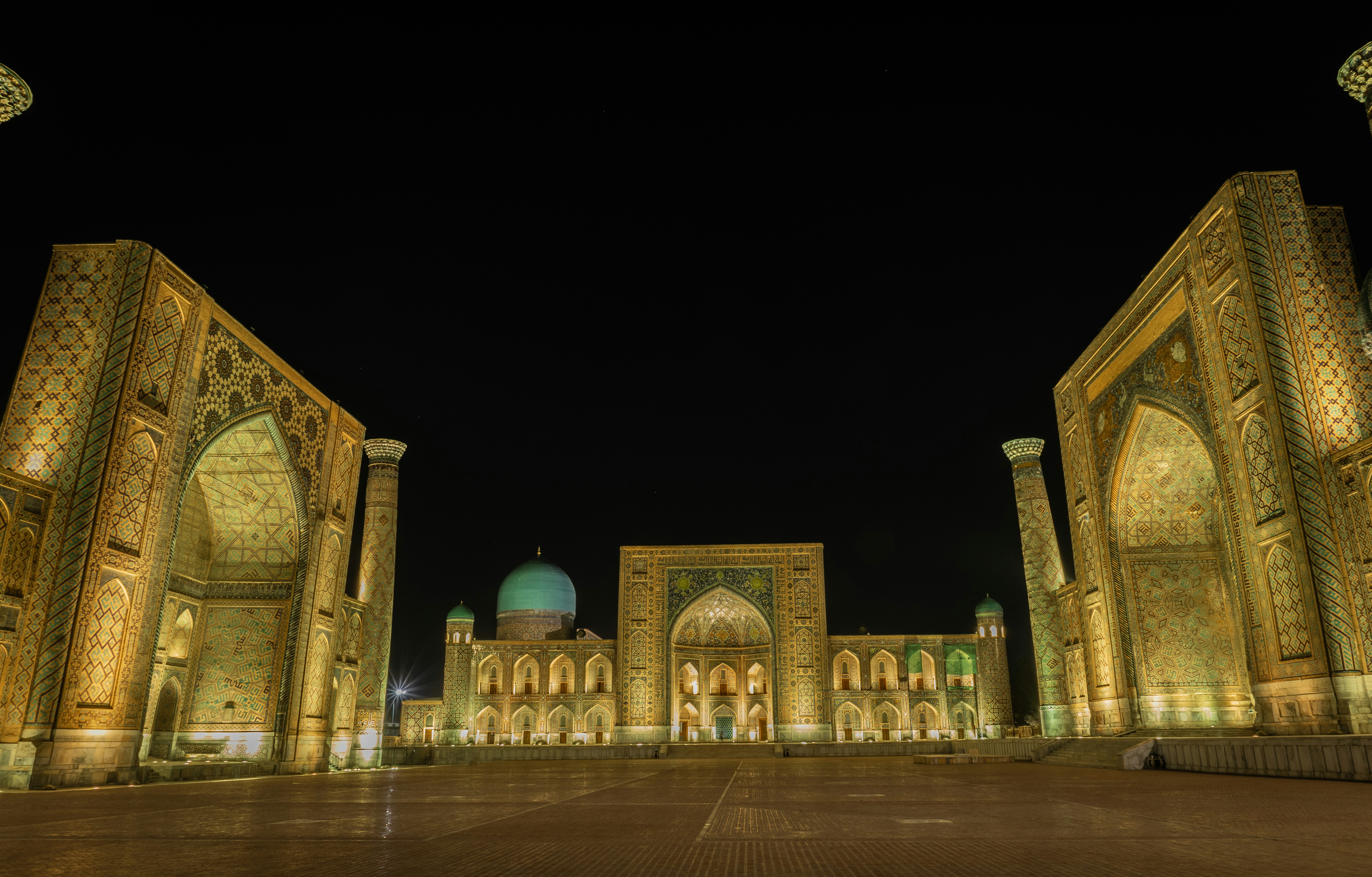
The heart of ancient Samarkand, Registan Square is flanked by three gr…
From 40,000 UZS

Kok-Saray Hill (Samarkand Citadel) is a historic fortress mound in the…
Free entry

Mazar and memorial complex of Faqih Abu Lays Samarkandi is a sacred pi…
Free entry

Mausoleum and Complex of Imam ad-Darimi — a revered religious-memorial…
Free entry