
Search attractions, restaurants, events...
30 min
Duration
Free
Free entry
Daytime
Best time to visit
Spiritual
Category
Foundation and construction of the prayer house (1898–1903)
The first Armenian craftsmen appeared in Samarkand as early as the 14th–15th centuries at the court of Amir Temur, but a permanent community formed at the end of the 19th century after Samarkand became part of the Russian Empire.
In 1898, priest Kevork Zakharyants received the first permission to open a temporary prayer house.
In May 1903, his successor Father Ruben Bekgulyants and the board of trustees secured the purchase of a vacant plot of 643 square sazhens on Chernyayevsky Prospekt. The petition was supported by the military governor of Samarkand, Lieutenant General Medinsky, and the Governor-General of the Turkestan Krai.
By the end of 1903, construction work was completed, and the parishioners gained their own stone building. In 1905–1906, a parish school opened at the church, where dozens of boys and girls studied, and the prayer house itself was expanded with the addition of a bell tower and a stone altar.
Architectural appearance and traditions
Architecture: The building combines the traditions of classical Armenian church architecture and local brick architecture. The facades are laid of shaped brick in an ochre-sand hue, the portals are decorated with arched niches.
Bell tower and decoration: Above the main entrance rises a tiered bell tower, crowned with a hipped dome with a bronze cross. The interior hall is decorated with a carved altar, images of the Mother of God and traditional Armenian khachkars.
A cozy shady courtyard was laid out at the church, enclosed by a brick wall, where the priest's house and the parish house were also located.
Closure in 1939 and revival in 1995
By a resolution of the Samarkand City Council of August 1, 1939 (after the arrest of the rector), the church was closed, and the building was handed over as a dormitory for the agricultural institute. Over half a century, the interior decoration was lost.
The revival of the shrine began in 1991 on the initiative of the Samarkand Armenian Cultural Center «Luys» («Svetoch»):
At the petition of the diaspora and with the assistance of the Catholicos of All Armenians Vazgen I, the city authorities handed the historic building over to the community.
The restoration lasted more than two years: the bells were delivered from Voronezh, the crystal chandeliers from Yerevan, and the wall paintings were executed by artists Pavel Arakelyan and Anatoly Polyantsev.
On August 20, 1995, the historic consecration of the church took place by Archbishop Nerses Pozapolyan in the presence of a representative state delegation from Armenia and hundreds of guests from the countries of Central Asia.
Today, services are regularly held at the church of Surp Astvatsatsin, a Sunday school of Armenian language, history and culture operates, and the church is a symbol of centuries-long friendship and interfaith harmony in Samarkand.
Monday: 09:00 – 18:00
Tuesday: 09:00 – 18:00
Wednesday: 09:00 – 18:00
Thursday: 09:00 – 18:00
Friday: 09:00 – 18:00
Saturday: 09:00 – 18:00
Sunday: 09:00 – 18:00
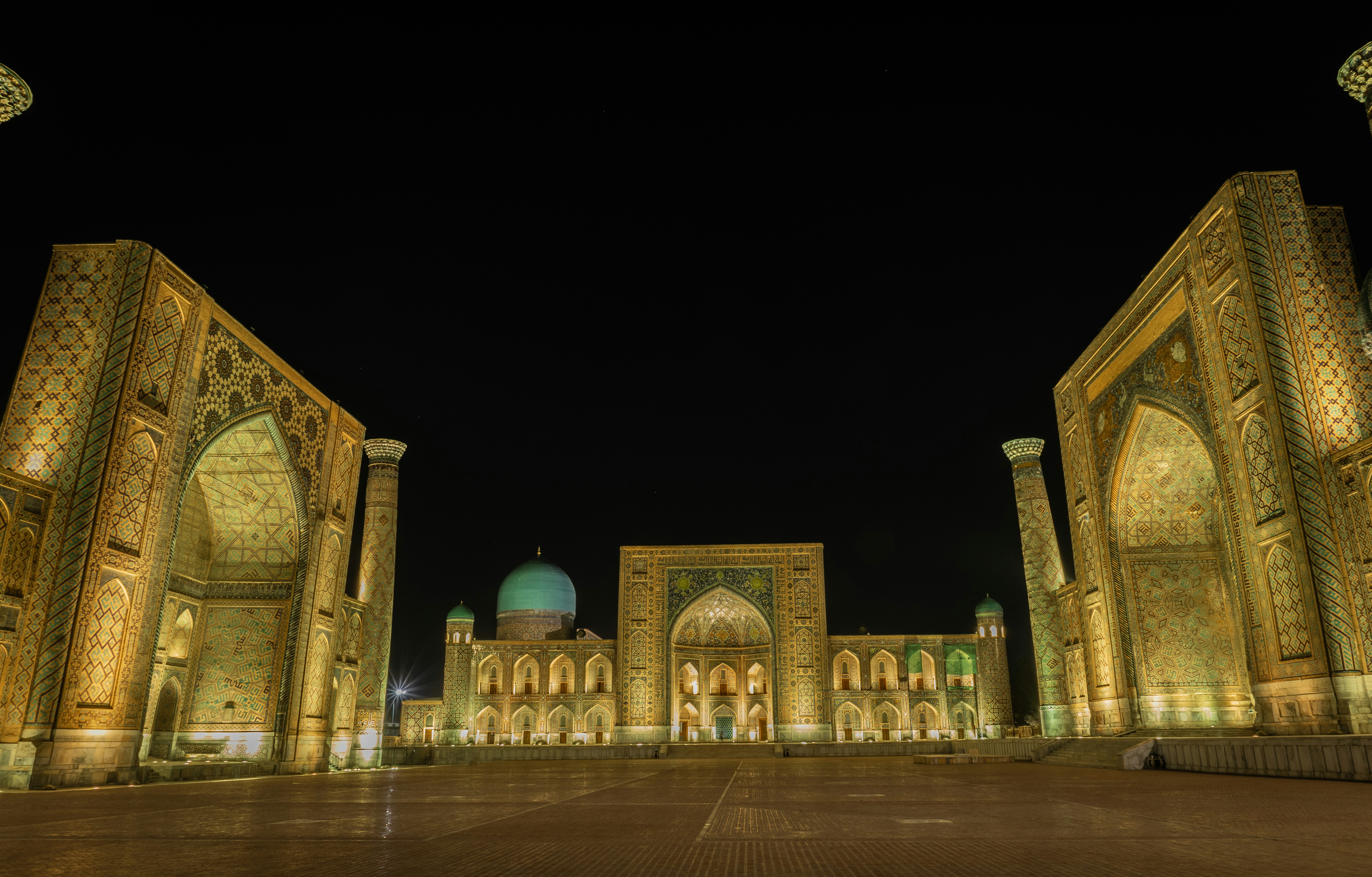
The heart of ancient Samarkand, Registan Square is flanked by three gr…
From 40,000 UZS

Kok-Saray Hill (Samarkand Citadel) is a historic fortress mound in the…
Free entry

Mazar and memorial complex of Faqih Abu Lays Samarkandi is a sacred pi…
Free entry

Mausoleum and Complex of Imam ad-Darimi — a revered religious-memorial…
Free entry